|
 Traveling
Well Traveling
Well
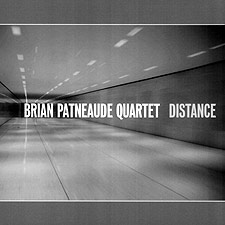
Brian
Patneaude Quartet
Distance
(WEPA)
Seven original compositions comprise this second CD release
from tenor saxist Patneaude, all of them deceptively accessible,
flavored with rhythm and melody thats fun and funky and sure
to lift your spirits. But its also stuff that stays with
you. The Distance of the titleits also the title of cut
sixis what youre invited to travel with this music.
And
the title cut also gives an idea of the complexity of the
tunes. Drummer Danny Whelchel stays busy throughout with a
quiet but busy figure over which Patneaude spins a slow, almost
melancholy figure. Everyone gets to shine, including Dave
Payette on Fender Rhodes, who sits in on two other numbers
as well.
You hear the ghosts of Michael Brecker and David Sanborn in
Patneaudes playing, but these are only part of a synthesis
of sound and style that add up to a unique voice. His playing
is lyrical, its introspective, but it keeps on driving.
Change
is a bouncy, bossa-tinged number that sets up the new CD,
letting us know that its a cooperative venture in which all
of the players happily participate. George Muscatellos guitar
is a continual presence, shading the harmony and adding another
degree of rhythmic complexity; when acoustic bass player Ryan
Lukas steps out for a solo, you realize how fundamental his
sound already has been throughout the piece.
Even a ballad like Alone, glistening with nice cymbal work
by Whelchel, has a propulsion that keeps it from getting maudlin.
With a compelling set of words, the tune would be a torch
singers dream.
And thats really Patneaudes secret. He plays the sax as
a lyrical instrument, well aware of its capacity to express
emotions. It shares with the violin the capacity to most closely
suggest the sound of human singing, and even in his busier
passagework, Patneaude sings. Even the punchy effects in Red,
one of the bouncier tunes on this disc, are rooted in lyricism.
The distance traveled is signified by Unending, the final
cut, an 11-minute journey reminiscent in its rhythm of Change,
but with a feeling of triumph attachedweve sung our songs
and sung them well. A final bow for the individual players,
and then they ease away. Youll hit the play button again.
B.A.
Nilsson
 Eric
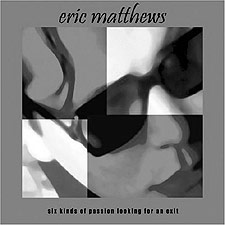
Matthews Eric
Matthews
Six
Kinds of Passion Looking For an Exit (Empyrean)
Its been eight years since Eric Matthews Lateness of
the Hour. It was one of a pair of his released by Sub
Pop (the other, released in 1995, was Its Heavy in Here)
back in the days when they were scrambling to find a new identity
as grunge was wearing right through the soles of its shoes.
Six
Kinds of Passion Looking For an Exit is a title with one
word more than the number of songs on this impressive CD.
Though half of them are more than six minutes in length, none
feels longsuch is the power of Matthews approach to the
rich, deep arrangements. The album is lushly orchestral in
the writing and structuring of each song, with nary a string
section in sight. The hushed tone of his singing is deceptively
powerful, underscoring a mix of yearning and melancholy that
flows through the whole set. When Matthews does move into
the realm of truly belting out a line (as on Do You Really
Want It?) its a bracing and dramatic shift. The judicious
mixing of acoustic and electric guitars, keyboards, a rhythm
section, and dollops of brass is done with an arrangers eye
for detail. Its all about the songs, not the band.
David
Greenberger
The
Kentucky Colonels
Appalachian
Swing (EMI)
The
Kentucky Colonels 1964 all-instrumental album Appalachian
Swing was a milestone in bluegrass history. It was on
this record, now remastered and reissued with three bonus
tracks for its 40th anniversary, that 19-year-old Clarence
White of later Byrds fame freed the guitar from its role within
the genre as a backup instrument and established it as a full-fledged
lead voice. White, who counted Jerry Garcia and Tony Rice
among his fans, derived his style from the flashy, syncopated
playing of North Carolina singer and flatpicker Doc Watson
and adapted it to the ensemble needs of bluegrass. His fleet-fingered
soloing, along with the talents of his older brother Roland
on mandolin and other bandmates Billy Ray Lathum on banjo,
Roger Bush on banjo and double bass, and Bobby Slone on fiddle
and double bass, made Appalachian Swing a classic,
and this a welcome rerelease.
Shortly after World Pacific issued the original 12-track,
27-minute LP, the label used members of the California-based
band including the White brothers to back dobroist Tut Taylor
on the LP Dobro Country. Many bluegrass fans consider
these sessions an extension of Appalachian Swing, so
the CD has been fleshed out with three of Taylors recently
rediscovered tracks.
The Colonels didnt stick to the usual bluegrass repertoire
in their choice of material herethey also dish up fiddle
tunes, Southern nostalgia songs, Western swing numbers, folk
songs and early country classics. As pickers, Clarence Whites
bandmates might not have broken new ground the way he did,
but they played just as well. This is clear from the start,
where Billy Ray Lathum tears up the Scruggs-style banjo warhorse
Clinch Mountain Backstep. On the next cut, Nine Pound Hammer,
Whites picking is supple and articulate, and remains so when
he trades choruses with Roland on Billy in the Lowground,
John Henry and Listen to the Mockingbird. The ill-starred
guitarist (he was killed in 1971 by a drunk driver in a hit-and-run
accident) also shines on I Am a Pilgrim when he takes advantage
of the relaxed tempo to throw in dazzling blues polyrhythms
on his famously dulcet-toned 1935 Martin D-28. Guest dobroist
Leroy Mack NcNees twangs away on the outlaw ballad Wild Bill
Jones, and Slone, usually the bassist, mimicks the sounds
of a car chase with his fiddle, police sirens and all, on
Lee Highway Blues.
Appalachian
Swing is not without a few sour notes. On some of the
tracks, the pitch of the closing chord drifts, leaving you
wishing someone had been more careful (whether the error occurred
during the original analog recording or the digital remastering
is not clear). No biggie, thoughfor bluegrass fans and guitar
pickers of all persuasions, this is still an essential CD.
Glenn
Weiser
|


 Columns
& Opinions
Columns
& Opinions

